How Technology Transformed the World's Largest Financial Market
The foreign exchange (Forex) market has undergone one of the most remarkable technological transformations in modern financial history. What began as a market reserved for central banks, multinational corporations, and major financial institutions has evolved into a globally accessible marketplace where millions of traders participate every day.
According to the Bank for International Settlements (BIS), the global Forex market reached an average daily trading volume of USD 9.6 trillion in 2025, making it the largest and most liquid financial market in the world. This represents a significant increase from the USD 7.5 trillion reported in 2022, highlighting the continued expansion of online Forex trading and digital financial services.
The evolution of Forex trading has been driven by advances in technology, communication, payment systems, and trading infrastructure. Understanding this transformation provides valuable insight into how today's markets operate and where the future of trading is heading.
Forex Trading in the 1970s: A Market for Institutions
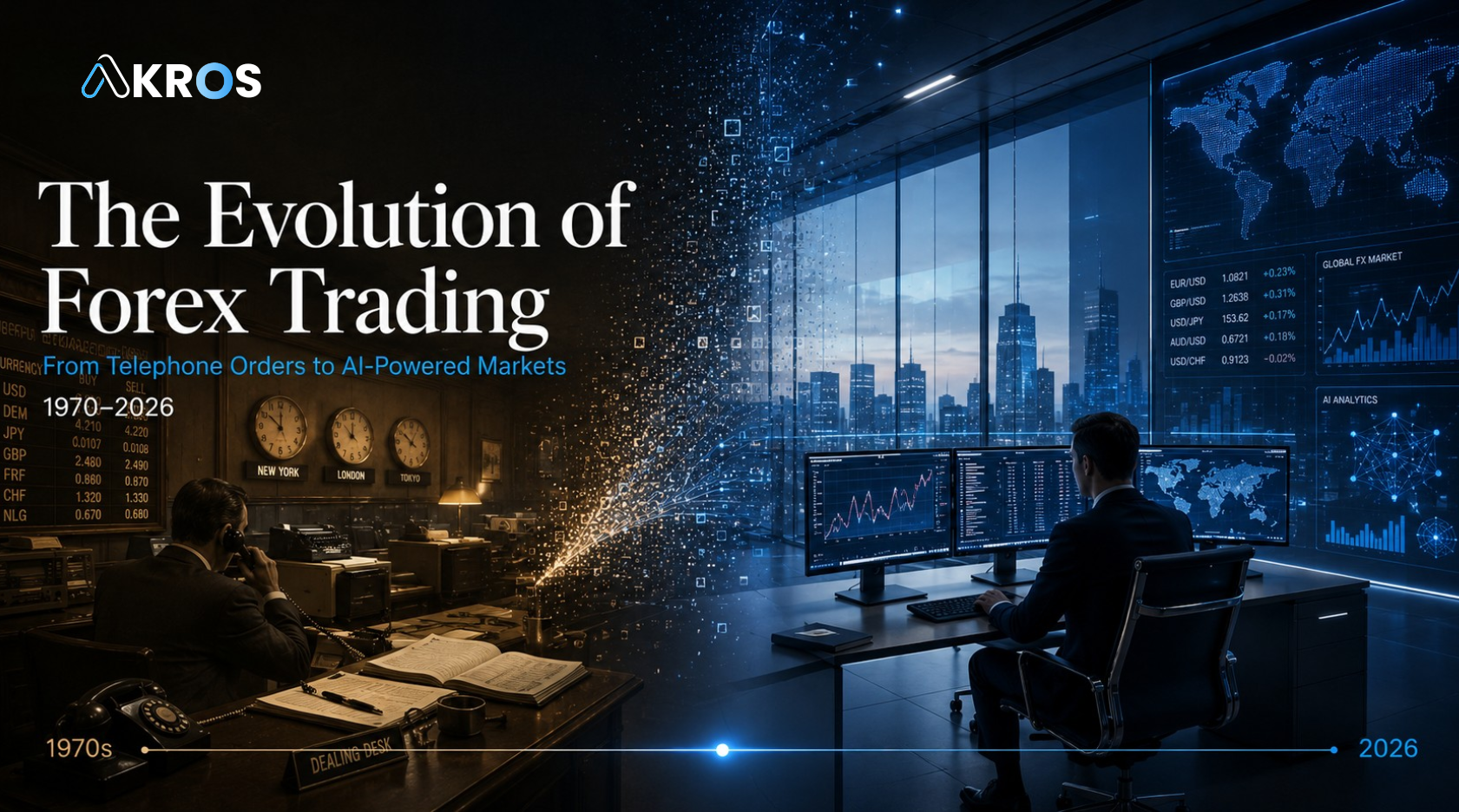
During the 1970s, Forex trading looked entirely different from the highly connected marketplace we know today.
Currency transactions were conducted primarily by:
- Central banks
- Commercial banks
- Multinational corporations
- Institutional investors
Retail participation was virtually nonexistent.
Trade execution relied heavily on telephone conversations, fax communications, and physical dealing rooms. Orders often required manual confirmation, while international wire transfers typically took between three and seven business days to complete.
Access to foreign exchange markets was limited, transaction costs were high, and execution speeds were measured in minutes—or even hours—rather than milliseconds.
For most individuals, participating in the Forex market was simply not an option.
The Digital Revolution Changed Everything
The arrival of the internet fundamentally reshaped global financial markets.
Electronic trading platforms replaced traditional telephone dealing, allowing investors to execute trades instantly from virtually anywhere in the world.
Modern Forex trading platforms now provide:
- Real-time market prices
- Advanced technical analysis tools
- Automated order execution
- Risk management features
- Multi-device trading access
- Instant market news and economic updates
Execution speeds that once required several minutes are now completed in milliseconds, creating greater market efficiency and significantly improving liquidity.
As trading technology matured, competition among brokers also increased, resulting in tighter spreads, lower trading costs, and improved execution quality for traders worldwide.
Artificial Intelligence Is Reshaping Modern Forex Trading
Artificial Intelligence (AI) has become one of the most influential innovations in today's financial markets.
Rather than relying solely on manual chart analysis, traders now have access to sophisticated technologies capable of processing enormous volumes of market data within seconds.
AI-powered tools assist traders by:
- Identifying market patterns
- Monitoring economic announcements
- Detecting trading opportunities
- Supporting quantitative analysis
- Improving execution efficiency
- Assisting with risk management
Although AI does not eliminate market risk or guarantee profitable outcomes, it has become an increasingly valuable decision-support tool for both retail and institutional traders.
Faster Payments and Global Market Accessibility
Technology has transformed not only how traders analyze markets but also how they move capital.
Historically, international deposits and withdrawals often required several business days to process.
Today, digital banking infrastructure, electronic payment solutions, and blockchain-based technologies have significantly accelerated cross-border transactions, improving both transparency and operational efficiency.
Combined with cloud-based trading platforms and high-speed internet connectivity, these innovations have made Forex trading more accessible than ever before.
Today, traders can monitor markets, manage positions, and access their accounts from almost anywhere using desktop or mobile devices.
Why Choosing the Right Forex Broker Matters
Despite rapid technological progress, successful Forex trading depends on much more than advanced software.
Choosing a reliable Forex broker remains one of the most important decisions every trader makes.
A professional broker should provide:
- Secure trading infrastructure
- Transparent pricing
- Reliable order execution
- Competitive spreads
- Robust risk management tools
- Responsive customer support
- Access to professional trading platforms
Technology can improve execution, but long-term success is built on education, discipline, effective risk management, and trading with a trusted financial partner.
The Future of Forex Trading
The Forex market continues to evolve as artificial intelligence, automation, cloud computing, and blockchain technologies reshape the global financial landscape.
As innovation accelerates, traders increasingly benefit from faster execution, improved analytical tools, greater market transparency, and broader access to international financial markets.
Understanding how Forex has evolved—from telephone-based trading desks to AI-powered digital platforms—helps traders appreciate both the opportunities and responsibilities that come with participating in today's global markets.
Trade the Modern Forex Market with AKROS
At AKROS, we are committed to providing traders with a modern trading environment built on technology, transparency, and professional support.
Through advanced trading platforms, competitive trading conditions, institutional-grade execution, and continuous market insights, we help traders access today's financial markets with confidence.
Whether you are opening your first trading account or expanding your trading experience, AKROS provides the tools and infrastructure designed to support your journey in today's fast-moving Forex market.
Frequently Asked Questions
What is Forex trading?
Forex trading is the buying and selling of currencies in the global foreign exchange market. It is the largest financial market in the world, operating 24 hours a day, five days a week.
How has Forex trading changed over the years?
Forex trading has evolved from manual telephone-based transactions conducted by financial institutions into a fully digital marketplace powered by online trading platforms, automation, and artificial intelligence.
Why is technology important in Forex trading?
Technology enables faster trade execution, improved market analysis, lower transaction costs, enhanced security, and easier access to global financial markets.
What should traders look for in a Forex broker?
Traders should consider regulation where applicable, execution quality, transparent pricing, trading platforms, customer support, available markets, and risk management tools before choosing a Forex broker.