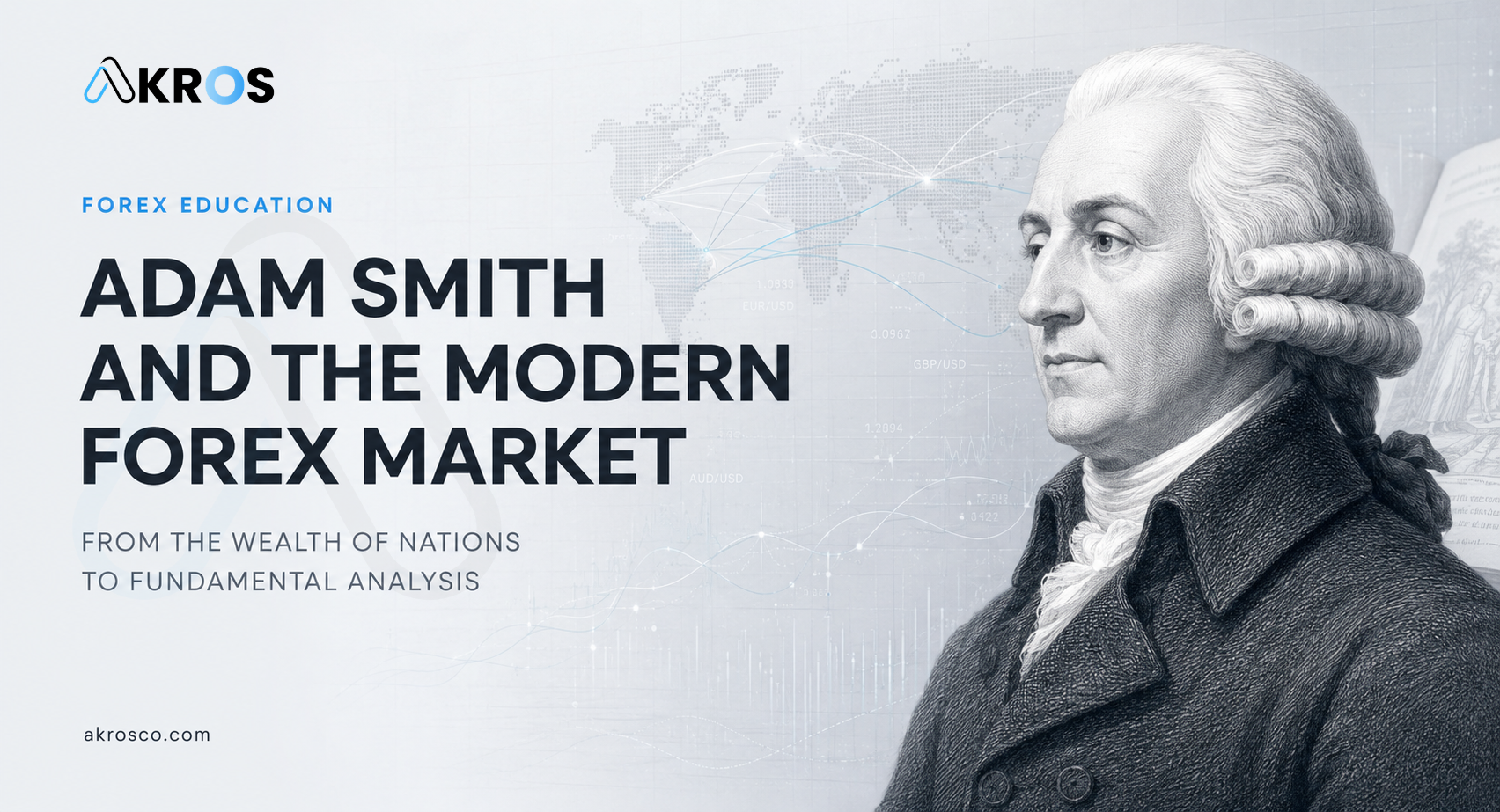
More than two centuries before currencies were traded through electronic platforms, Adam Smith studied the forces that shape national wealth, productivity, trade and market prices.
Smith was an 18th-century Scottish economist and philosopher whose 1776 book, The Wealth of Nations, helped establish important foundations of classical economics. His work on specialization, productivity, trade and markets provides useful context for understanding modern fundamental analysis and the economic forces influencing currency markets.
Who Was Adam Smith?
Adam Smith was born in Scotland in 1723 and became one of history’s most influential economic thinkers. Although he is often called the father of modern economics, his interests extended beyond money and markets. He studied moral philosophy, human behavior, political institutions and the organization of society.
This broader perspective remains relevant today because financial markets do not operate in isolation. Currencies can react to economic data, government policies, central-bank decisions, investor confidence and changing expectations.
What Is The Wealth of Nations?
Published in 1776, An Inquiry into the Nature and Causes of the Wealth of Nations examined how countries create prosperity.
Smith argued that national wealth depends heavily on an economy’s productive capacity and on how effectively it uses labor, skills, capital and other resources. These subjects remain central to modern economic analysis.
Forex traders now monitor indicators such as GDP growth, employment, inflation, productivity, consumer spending, international trade and interest rates when evaluating currencies.
When analyzing a pair such as EUR/USD or GBP/USD, traders are comparing two currencies, two monetary systems and two economic outlooks. The exchange rate reflects the market’s changing assessment of that comparison, alongside risk sentiment and global capital flows.
Division of Labor and Productivity
One of Smith’s best-known ideas was the division of labor.
Instead of one worker completing every stage of production, specialization allows individuals to focus on particular tasks. Smith argued that specialization could increase skills, save time and improve production efficiency.
Modern economies operate according to similar principles. Countries may develop strengths in technology, manufacturing, agriculture, energy, financial services or other sectors according to their resources, institutions and expertise.
Higher productivity can support economic growth, improve export competitiveness and attract investment. For forex traders, productivity is therefore part of the long-term economic picture behind a currency.
However, productivity alone does not determine currency performance. Inflation, interest rates, fiscal conditions, market expectations and political risk must also be considered.
Free Markets and Price Discovery
Adam Smith became closely associated with the idea that markets can coordinate economic activity through decentralized decisions.
His famous “invisible hand” metaphor described how individuals pursuing their own interests may, under appropriate institutional conditions, contribute to broader economic outcomes they did not originally intend.
When demand for a product increases relative to supply, its price may rise. Higher prices can encourage producers to increase supply. When supply becomes excessive relative to demand, prices may experience downward pressure.
Modern financial markets use a comparable price-discovery process. Every movement in a currency pair reflects buyers and sellers reassessing economic value, policy expectations, risk and future returns.
This does not mean markets are always efficient or predictable. Uncertainty, incomplete information and changing expectations can create significant volatility.
Supply, Demand and Currency Valuation
The modern aggregate supply and aggregate demand framework developed long after Adam Smith and should not be presented as a theory created by him. Nevertheless, it examines relationships among production, spending, inflation and economic activity that connect naturally with questions explored in classical economics.
If economic demand grows faster than productive capacity, inflationary pressure may develop. Depending on their mandates and economic outlook, central banks may respond by maintaining tighter monetary policy or raising interest rates.
Under certain conditions, higher interest rates can make assets denominated in a currency more attractive to international investors. This may increase demand for that currency.
However, currency markets also consider inflation expectations, economic growth, political stability, financial risk and the likely direction of future central-bank policy. Higher interest rates do not automatically guarantee a stronger currency.
Natural Resources and National Wealth
Natural resources can also influence a country’s economic structure.
Oil, natural gas, metals and agricultural products may generate export revenue, affect government income and influence the trade balance. Commodity prices can therefore have different effects on exporting and importing economies.
A sharp increase in oil prices, for example, may benefit some oil-producing countries while increasing costs and inflationary pressure in countries that depend heavily on energy imports.
This is one reason fundamental analysis looks beyond the currency chart. Understanding a currency often requires examining the productive, commercial and financial structure of the economy behind it.
Adam Smith and Fundamental Analysis
The connection between Adam Smith and the forex market is indirect but meaningful. Smith did not develop a theory of modern currency trading. Instead, his work examined economic relationships that provide useful historical context for fundamental analysis.
Fundamental traders may monitor:
- Economic growth and GDP
- Inflation and consumer-price data
- Employment and unemployment
- Central-bank interest rates
- Monetary and fiscal policy
- Productivity and industrial activity
- International trade
- Government debt and bond yields
- Commodity exposure
- Political and geopolitical risk
- Consumer and business confidence
- International capital flows
Each indicator provides only part of the economic picture. The objective is not simply to decide whether a number is “good” or “bad,” but to understand how it may change expectations about growth, inflation and future policy.
Markets may also react unexpectedly when an economic result has already been anticipated and reflected in prices.
What Can Forex Traders Learn from Adam Smith?
Adam Smith never traded currencies through an electronic platform, but several economic forces he studied remain embedded in modern markets:
- Productivity expands economic capacity.
- Specialization can improve efficiency.
- Trade connects economies and markets.
- Supply and demand influence prices.
- Capital responds to opportunity, risk and expected return.
- Economic conditions can influence the value of money.
These ideas form part of the intellectual background to fundamental analysis.
A chart shows what the market is doing. Economics helps traders investigate why the market may be doing it. Neither perspective removes uncertainty or guarantees a particular trading result.
The Economy Behind the Currency
Two and a half centuries after the publication of The Wealth of Nations, global markets have changed dramatically.
Currency trading now takes place across banks, institutions, corporations, investment funds and electronic platforms around the world. According to the Bank for International Settlements, average daily turnover in over-the-counter foreign-exchange markets reached $9.6 trillion in April 2025.
Despite these changes, traders continue to examine familiar economic questions:
Where is capital moving? Which economy’s outlook is improving? What is driving inflation? How are interest-rate expectations changing? Where is productivity increasing? How are countries trading with one another?
Understanding these relationships can help traders develop a more informed and disciplined approach to financial markets.
At AKROS, we believe trading education should extend beyond the chart. Understanding the economy behind a currency can help traders interpret market movements with greater context and awareness of risk.
Frequently Asked Questions
Who was Adam Smith?
Adam Smith was an 18th-century Scottish philosopher and economist and one of the most influential figures in classical economics. His work examined productivity, specialization, trade, markets and capital.
Why is Adam Smith called the father of modern economics?
Smith is often given this description because The Wealth of Nations systematically examined how labor, productivity, trade, capital and economic incentives contribute to national prosperity.
How are Adam Smith’s ideas connected to forex trading?
The connection is indirect. Economic forces such as productivity, trade, capital allocation, prices and national prosperity provide useful context for the modern fundamental analysis of currencies.
Why is fundamental analysis important in forex?
Fundamental analysis helps traders examine the economic conditions behind a currency. These may include GDP, inflation, employment, interest rates, monetary policy, trade and international capital flows.
Do higher interest rates always strengthen a currency?
No. Higher rates may make certain assets more attractive, but currencies also respond to market expectations, inflation, growth, political risk and the anticipated direction of future central-bank policy.
Understand the economy behind the currency.
Explore market education and fundamental analysis with AKROS and build a deeper understanding of the forces shaping global financial markets.
This material is provided for educational purposes only and does not constitute investment advice. Trading financial markets involves risk, and past performance does not guarantee future results.